How we modernized a B2B service website’s SEO strategy to capture traditional Google organic traffic while emerging as a trusted source for AI platforms like ChatGPT.
Welcome to this exclusive Service Website SEO Case Study. Due to a strict Non-Disclosure Agreement (NDA), the exact identity and specific niche of this B2B service provider must remain confidential. However, we are thrilled to share the transparent data and the exact optimization roadmap that led to their recent digital success.
Our client provides specialized digital solutions and consulting services. Before partnering with us, their website was functionally sound but struggled to generate meaningful organic traction. Their analytics showed minimal engagement, and they were completely invisible to the emerging wave of AI-driven search engines. Their goal was twofold: to establish dominance in traditional Google Search for their core service offerings and to future-proof their brand against the rapid rise of Generative AI search behaviors.
When we conducted our initial audit of their web properties, we identified several critical bottlenecks preventing growth. As detailed in this Service Website SEO Case Study, the challenges were multifaceted:
The primary landing pages (including the homepage) lacked in-depth, authoritative content. They were not structured to answer the specific questions potential clients were asking.
Search engines (and AI models) did not clearly understand what the company actually did. The website lacked proper Schema markup to define its business entity, services, and expertise.
Visitors who did land on the site were bouncing quickly due to poor internal linking and a lack of clear user journeys.
As users increasingly turn to platforms like ChatGPT for recommendations, this brand was nowhere to be found in those AI-generated responses.
To overcome these hurdles, we moved beyond basic keyword insertion. We deployed an advanced, entity-first strategy designed to satisfy both human users and complex machine-learning algorithms.
To ensure search engines and AI language models perfectly understood the client's offerings, we implemented robust 'LocalBusiness' and 'Service' Schema markup. We clearly defined the brand's identity, connected it to authoritative external knowledge bases, and structured their service data meticulously.
This Service Website SEO Case Study highlights a shift toward Artificial Intelligence Engine Optimization (AEO). We revamped the homepage and core service pages, ensuring they directly answered complex, conversational queries. We structured content using clear H2 and H3 tags, bullet points, and definitive statements—the exact formatting that Large Language Models (LLMs) like ChatGPT prefer to cite.
To signal quality to search engines, we significantly improved the site's engagement rates. We created logical, sticky navigation paths and enriched the content with high-quality media, ensuring users stayed longer and interacted deeply with the service offerings.
Given the site was built on Webflow, we optimized the platform's specific technical nuances. We cleaned up the code, improved page load speeds, and ensured perfect mobile responsiveness, aligning perfectly with Google's core ranking fundamentals.
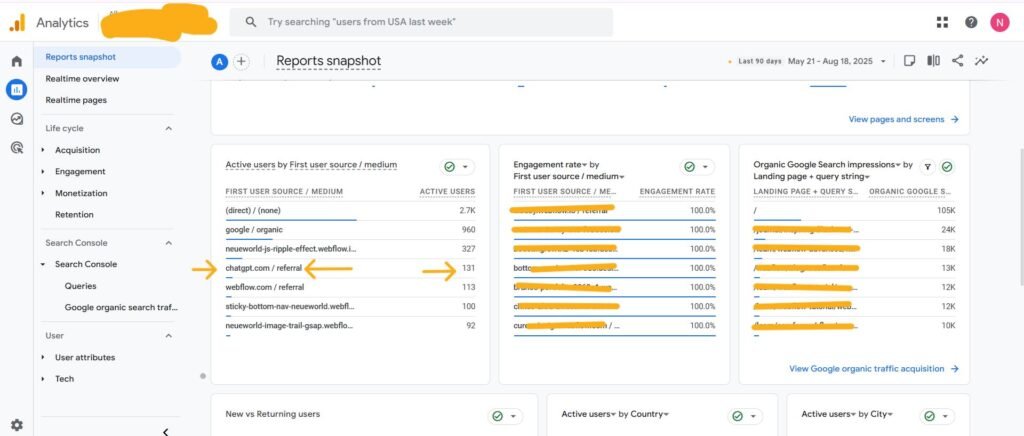
The recent 90-day snapshot from Google Analytics 4 (GA4) perfectly illustrates the success of our dual-pronged strategy. By focusing on deep technical health and entity optimization, we achieved remarkable milestones:
As seen in the GA4 'Organic Google Search' widget, the homepage alone exploded in visibility, generating over 105K impressions. This proves that our content expansion and entity definition successfully aligned the site with high-volume search queries.
Google Organic emerged as a primary driver, bringing in nearly 1,000 highly engaged active users during this period.
The traffic we acquired was incredibly high-intent. Across multiple landing pages and referral sources, the analytics recorded a stunning 100% engagement rate, meaning users were actively interacting with the content rather than bouncing.
Perhaps the most exciting result is the clear data showing 131 Active Users arriving directly via "chatgpt.com / referral". This confirms that our AEO (Artificial Intelligence Engine Optimization) strategies worked. The client's brand is now actively being recommended by ChatGPT as a trusted solution provider to its users.
This Service Website SEO Case Study proves that modern SEO requires a holistic approach. By building authoritative, technically sound, and well-structured digital entities, you can dominate traditional Google SERPs while simultaneously capturing the future of AI-driven search traffic.