How we navigated complex technical challenges to build a highly profitable organic revenue stream for a brand-new online retail store.
Welcome to this comprehensive eCommerce SEO Case Study. Due to a strict Non-Disclosure Agreement (NDA) with our client, we are keeping their brand name and specific niche confidential. However, the data, strategies, and exact roadmap we used to achieve these staggering results are fully transparent.
The client launched a new online retail store selling a wide variety of lifestyle and consumer products. As you can see from the “Start From Here” marker on the Search Console graph, they were starting from absolute zero. They had no domain authority, no organic footprint, and thousands of product pages that Google didn’t even know existed. Their goal was simple but highly ambitious: to build a sustainable organic traffic channel that would reduce their reliance on expensive paid ads (PPC) and drive consistent daily sales.
Scaling a brand-new eCommerce website is notoriously difficult. When we initiated this project, we faced a mountain of challenges typical of eCommerce SEO Case Study large-scale online stores:
As a brand-new domain, the site was practically invisible. It lacked the trust and authority required to compete with established retail giants.
With thousands of products, category pages, and faceted navigation filters (e.g., sorting by size, color, or price), search engine bots were getting trapped. They were wasting crawl budget on useless filter pages instead of indexing the actual products.
Many product descriptions were either completely blank or copied directly from the manufacturer. This created massive duplicate content issues, preventing individual product pages from ranking.
The website lacked a logical hierarchy, making it difficult for both users and search engines to navigate from broad categories down to specific items.
To achieve the massive growth outlined in this eCommerce SEO Case Study, we deployed a multi-phase, data-driven strategy. We didn’t just build links; we completely overhauled the technical foundation of the store.
Our first priority was controlling how search engines interacted with the site. We implemented strict canonical tags on product variants (colors/sizes) to eliminate duplicate content. We also heavily restricted search engine access to faceted navigation URLs using the robots.txt file and dynamic parameter handling. We adhered strictly to Google's official guidelines for eCommerce sites to ensure optimal crawling and indexing.
Instead of trying to rank thousands of individual products, we focused our heavy lifting on the "Category" and "Sub-category" pages. We added SEO-optimized, human-readable descriptions at the top and bottom of these pages, seamlessly integrating commercial search terms without keyword stuffing.
To make the site stand out in the Search Engine Results Pages (SERPs), we deployed dynamic Product, Review, and Offer Schema markup across the entire inventory. eCommerce SEO Case Study This allowed the site to display price tags, availability (In Stock), and star ratings directly in Google, which drastically improved click-through rates.
We launched a supporting blog featuring "Buying Guides" and "Top 10" lists relevant to their products. This Top-of-Funnel (ToFu) content attracted high-quality backlinks and allowed us to internally link to priority product categories, passing valuable link equity down the funnel.
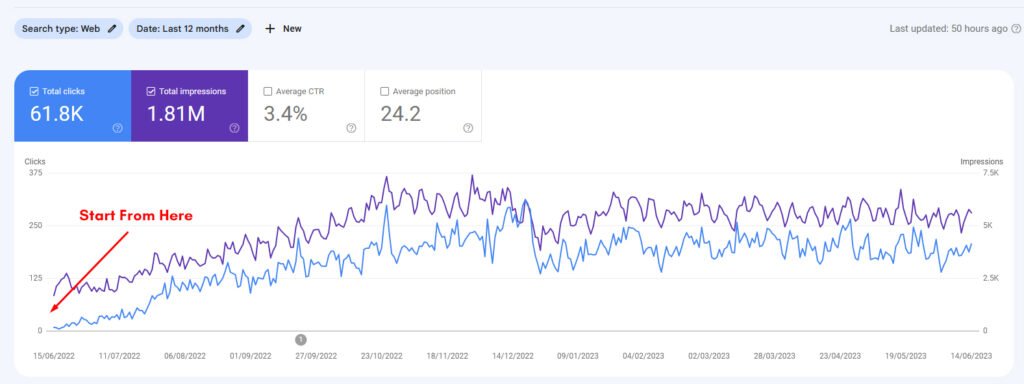
The 12-month Google Search Console data speaks for itself. Starting from a flatline, our compounding SEO efforts resulted in a beautiful, consistent upward trajectory. Within one year, we achieved:
The brand went from total obscurity to becoming a highly visible player in their niche, getting their products in front of nearly 2 million potential buyers.
We drove a massive volume of high-intent shoppers directly to their category and product pages. eCommerce SEO Case Study
Considering the sheer volume of impressions and the broad nature of eCommerce keywords, maintaining a 3.4% click-through rate demonstrates highly effective meta tags and rich snippets.
The graph clearly shows the momentum building after the first 3 months, proving that our technical fixes and authority-building efforts successfully signaled trust to Google's algorithms.
This eCommerce SEO Case Study proves that even in highly saturated markets, a technically sound website paired with a strategic category-first approach can scale from zero to tens of thousands of monthly visitors in just one year.