Welcome to an advanced fashion brand Facebook ads case study. Explore the exact media buying architecture we deployed to manage, structure, and scale dozens of simultaneous campaigns for a fast-growing apparel company.
When we took over the ad account featured in this snapshot, it had hundreds of historical campaigns.
There was a severe case of audience overlap.
Different campaigns from the same account were literally competing against each other in the Facebook auction.
This internal competition was artificially driving up their Cost Per Click (CPC).
Here is what we found during the initial phase of our fashion brand Facebook ads case study:
Broken Catalog Integration: Their dynamic product ads (DPA) were displaying out-of-stock items.
No Funnel Structure: They were treating cold audiences and warm website visitors with the exact same messaging.
Wasted Micro-Budgets: They had dozens of ad sets spending $5 a day, achieving nothing.
We had to hit the pause button on the underperformers and engineer a full-funnel ecosystem.
We executed a massive account consolidation.
To turn this disorganized account into a benchmark fashion brand Facebook ads case study, we categorized their media buying into distinct, highly controlled phases.
Here is the exact framework we deployed:
Phase A: Dynamic Catalog Sales (The Engine)
For a brand with multiple SKUs, Dynamic Product Ads are non-negotiable.
We fixed their Shopify-to-Meta pixel integration.
We launched specific ‘Catalog Sales’ campaigns (as seen in the “Eid days test catalog” from the dashboard).
We utilized Advantage+ Catalog ads to automatically serve the most relevant clothing items to users based on their browsing history.
This automated personalization instantly dropped the acquisition cost for high-intent buyers.
Phase B: Top of Funnel (Targeting Cold Traffic)
We needed to introduce the brand to new buyers without burning cash.
We created consolidated CBO (Campaign Budget Optimization) campaigns.
We launched specific seasonal pushes, such as the “Jacket Sales” and “Winter Boots” campaigns.
Instead of hyper-targeting, we utilized broad audiences and 10% Lookalike audiences based on high-LTV customers.
We let the ad creatives (user-generated styling videos) do the targeting naturally.
Phase C: Audience Nurturing & Retargeting
Not everyone buys a $50 jacket on the first click.
We deployed mid-funnel campaigns designed strictly for engagement.
We ran micro-budget “Page Like” and “Display” campaigns to build retargeting pools.
We hit cart-abandoners with aggressive, time-sensitive discount codes via Dynamic Retargeting.
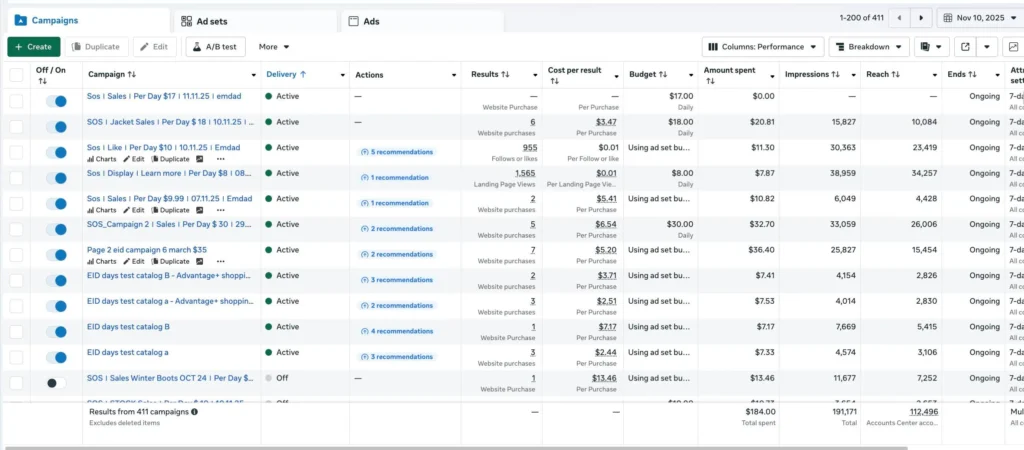
The dashboard screenshot attached to this fashion brand Facebook ads case study illustrates a highly mature, functioning ad account.
You will notice that the Cost Per Purchase varies across different campaigns (ranging from $2.44 to $13.46).
This is exactly what a healthy, multi-tiered ad funnel looks like.
Understanding the Dashboard Metrics:
Top of Funnel Costs: Campaigns targeting completely cold audiences naturally have a higher CPA (e.g., $13.46). These campaigns are doing the heavy lifting of acquiring brand new customers.
Retargeting Efficiency: The catalog and retargeting campaigns are picking up the easy conversions at extremely low costs (e.g., $2.44 and $3.71 per purchase).
Controlled Daily Spend: By using specific daily budgets ($17, $30, etc.) on winning ad sets, we maintained strict liquidity without overspending.
Omnichannel Synergy: The engagement and like campaigns fed cheaper traffic into the expensive sales campaigns, lowering the blended CPA across the entire account.
[Section 5: Managing Seasonal Drops]
H2 Headline: The Secret to Holiday Scaling
Apparel brands live and die by their seasonal collections.
A core component of this specific fashion brand Facebook ads case study was navigating massive cultural and seasonal events.
Whether it was a Winter Boots launch or an Eid festival catalog push, speed was critical.
We prepared all ad creatives 14 days before the seasonal drop.
We utilized automated rules to scale budgets by 20% every 48 hours if the ROAS was above our KPI target.
We heavily utilized urgency-driven copy (e.g., “Final 48 Hours for Express Shipping”).
This allowed the brand to maximize revenue during peak consumer buying windows.
Stop launching random campaigns and hoping they stick.
If your ad account looks like a disorganized mess, you are leaving massive profits on the table.
To implement the exact full-funnel architecture detailed in this fashion brand Facebook ads case study, you need a team that understands advanced media buying.
Our senior strategists are ready to tear down your current setup and rebuild it for maximum profitability.